SAA Nigeria Strengthens Agricultrural Extension and Human Cpaital Development Across Three States
The Sasakawa Africa Association (SAA) Nigeria is strengthening agricultural extension systems and building a pipeline of skilled agricultural professionals through targeted capacity-building interventions across higher education institutions and public extension services. With funding support from The Nippon Foundation (TNF), SAA’s Capacity Building (CB) Unit reached 13 higher education institutions and directly benefited 240 participants in the past year through practical training, technical support, curriculum development, and knowledge-sharing initiatives.
The interventions are designed to bridge the gap between academic learning and field practice while enhancing the capacity of extension workers, students, agrodealers, and other agricultural stakeholders to respond to emerging challenges in food systems, climate resilience, and sustainable agriculture.
Strengthening Agricutral Extension Systems
According to Dr. Godwin Atser, Country Director of SAA Nigeria, capacity development remains central to SAA’s mission of strengthening agricultural advisory services and improving outcomes for smallholder farmers.
“Our goal is not just to deliver training, but to strengthen the extension system itself. Over the last 34 years, we have supported mid-career extension workers through extension education up to PhD level and continue to partner with State Agricultural Development Programmes (ADPs) and academic institutions to build a more responsive and effective extension service delivery system,” he said.
The initiative reflects SAA’s long-standing commitment to strengthening agricultural advisory services by investing in the people and institutions that support farmers across Nigeria.
Expanding Technical Skills and Curriculum Development
Beyond training delivery, the Capacity Building Unit continued to provide technical support to enrolled extension students, helping to strengthen practical learning and professional development. The unit also trained agrodealers and extension agents on safe-use and contributed to the development of technical manuals and training resources for Climate-Resilient and Sustainable Agrifood Systems, Inclusive Markets and Agri-business Development, and Safe, Adequate & Nutritious Food Systems. In addition, SAA supported the development of an agricultural curriculum for Southwest Nigeria, contributing to efforts aimed at improving the quality and relevance of agricultural education.
Tailored Training to Reflect Local Realities
Speaking on the approach adopted for the interventions, Dr. Anjola Fadairo, Technical Coordinator for Capacity Building, explained that training content is tailored to the needs of each location and institution.
“We intentionally designed the training to reflect local realities and the specific needs of participants so that the knowledge gained could be immediately applied within their communities and workplaces,” she said.
This approach ensured that participants received practical skills and knowledge relevant to the agricultural challenges and opportunities within their respective regions.
State Level Impact
Kano State: Strengthening Practical Field Skills
This impact-focused approach was evident across the participating states. In Kano State, a one-week programme hosted at Bayero University, Kano (BUK), equipped extension personnel, SAFE alumni, and final-year agriculture students with practical skills in contract farming, Farmer Field Schools (FFS), Farmer Learning Platforms (FLPs), field layout, soil measurement, and biochar production and application.
The programme strengthened participants’ ability to support farmers through practical, field-based advisory approaches while promoting climate-resilient soil management practices.
Nasarawa State: Promoting Household Production and Youth Engagement
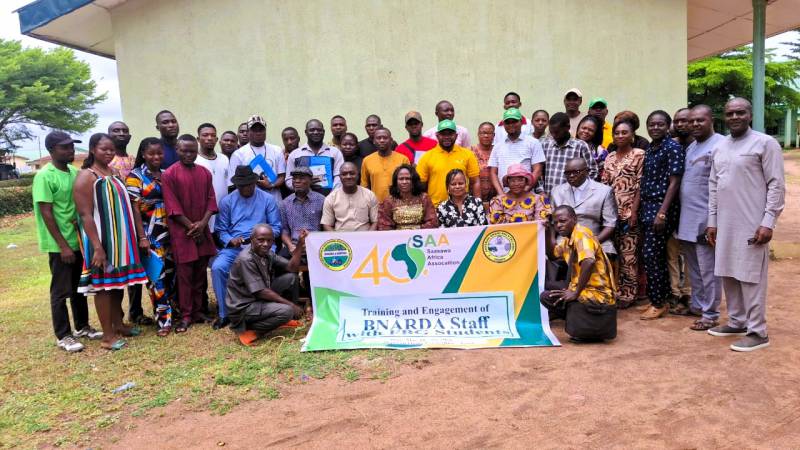
In Nasarawa State, the training supported the expansion of the Family Business Garden (FBG) model through collaboration between extension workers and students. Participants gained practical knowledge on irrigation practices, post-harvest management, and soil regeneration techniques. The application of biochar on the institution’s demonstration plots improved soil texture and provided a practical learning platform for participants. The training also encouraged greater youth participation in agriculture and strengthened interest in household food production and nutrition-sensitive farming.
Benue State: Soft Skills for Effective Advisory Services
Similarly, in Benue State, extension personnel received training on leadership, supervision, delegation, and group dynamics, critical competencies for effective community engagement and agricultural advisory service delivery. The enhanced soft skills are expected to improve collaboration, communication, and the overall effectiveness of extension services within farming communities.
Bridging Academia and Field Practice
Stakeholders across participating institutions acknowledged the value of the initiative in fostering stronger linkages between academia and practice. The programme created opportunities for experienced extension professionals and students to learn from one another, facilitating knowledge transfer while preparing the next generation of agricultural practitioners.
Through these interventions, SAA Nigeria continues to contribute to the development of a more resilient and effective agricultural extension ecosystem, one that combines technical expertise, practical experience, and institutional collaboration to better serve farming communities and advance sustainable agricultural development.
SAA Publications
E-newsletter
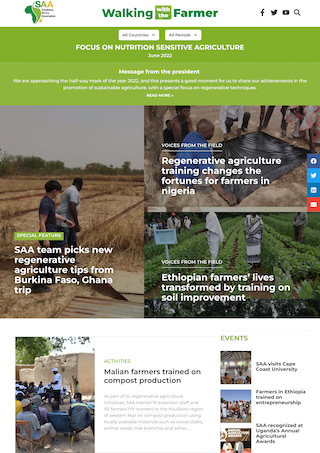
"Walking with the Farmer"
SAA publishes a bimonthly e-newsletter reporting on SAA activities.
SAA Mail News
Sign up to receive our e-newsletter and upcoming event information via email.

SAA history book
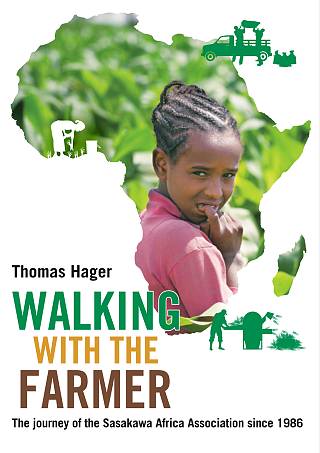
"Walking with the Farmer: The journey of the Sasakawa Africa Assoication since 1986"
This book chronicles the history of SAA from its inception to the present.

Annual Report
Annual Report FY2023
Annual Report FY2023 is available here.


