【Farmers' story】From flooded fields to climate solutions: How one Beninese farmer turned rice farming into a pathway for prosperity and decarbonization
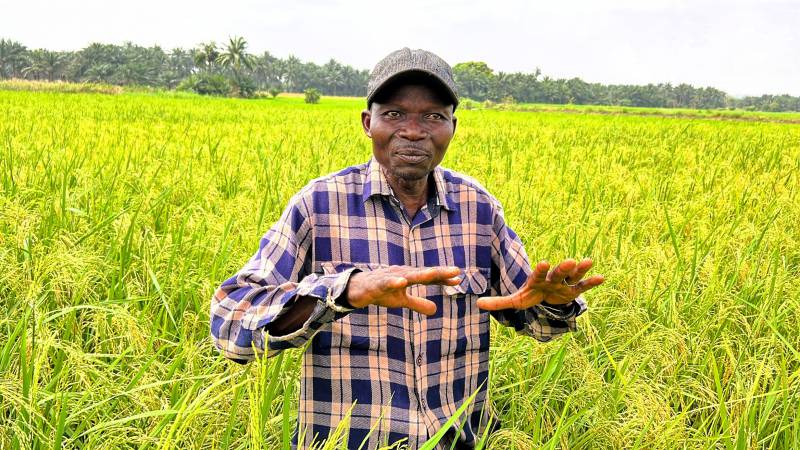
At dawn in Koussin Lélé, a low-lying rice-growing community in Benin’s Zou region, the paddies shimmer under a thin veil of water. For decades, scenes like this have symbolized both sustenance and struggle for smallholder farmers, fields that feed families, yet quietly release methane, a greenhouse gas far more potent than carbon dioxide. For farmers like Ahitchékpon Nestor, 50, rice was once a matter of survival alone. Today, it has become a story of climate action, innovation, and dignity restored.
Rice is at the heart of Benin’s food system, consumed daily across households and urban markets alike. Yet traditional flooded rice cultivation comes at a cost. When water stagnates in paddy fields, oxygen is cut off from the soil, creating conditions that allow methane-producing bacteria to thrive. Globally, flooded rice systems account for an estimated 9-10 percent of agricultural greenhouse gas emissions (FOA), making rice both a staple food and an unexpected climate challenge.
It was into this reality that the Improving Rice Productivity by Decarbonizing Cultivation for 12,000 Hectares of Irrigated Paddy Fields in the Republic of Benin project stepped in. Funded by the Policy and Human Resources Development Grant (PHRDG II) of the Government of Japan through the African Development Bank, and implemented by Sasakawa Africa Association (SAA) in partnership with SoftBank Corp, IITA, and TAAT, the project is proving that productivity and climate responsibility do not have to be mutually exclusive.
In three years, farmers in Zogbodomè, Lalo, and Covè districts were introduced to a suite of regenerative practices backed by scientific analysis and AI-powered e-Kakashi technology. The data told a clear story: smarter water and nutrient management could significantly reduce methane emissions while increasing yields. But on the ground, the transformation became real through a simple, locally named innovation, Urea Super Granules (USG), known affectionately as “Bombom.”
For years, most rice farmers in the region practiced fertilizer broadcasting, scattering urea across flooded fields. Much of it washed away or volatilized, leaving crops undernourished, farmers poorer, and the environment burdened with unnecessary emissions. USG changed that equation. By compressing urea into dense briquettes and placing them directly between rice seedlings, nutrients are protected from erosion and absorbed efficiently by the plant. The result is higher nitrogen-use efficiency, stronger crops, and fewer emissions.
Yet even the best technology can fail without local capacity. In Covè, SAA uncovered a forgotten asset: a urea briquetting machine abandoned at the agricultural development centre for more than 20 years. It had been left idle not because it was obsolete, but because no one had the technical know-how to operate or maintain it.
That discovery would quietly alter Mr. Nestor’s life.
“When they showed us the machine,” he recalls, standing beside neatly stacked bags of urea briquettes, “I could not believe it had been here all this time. We were struggling, and the solution was already in our community.”
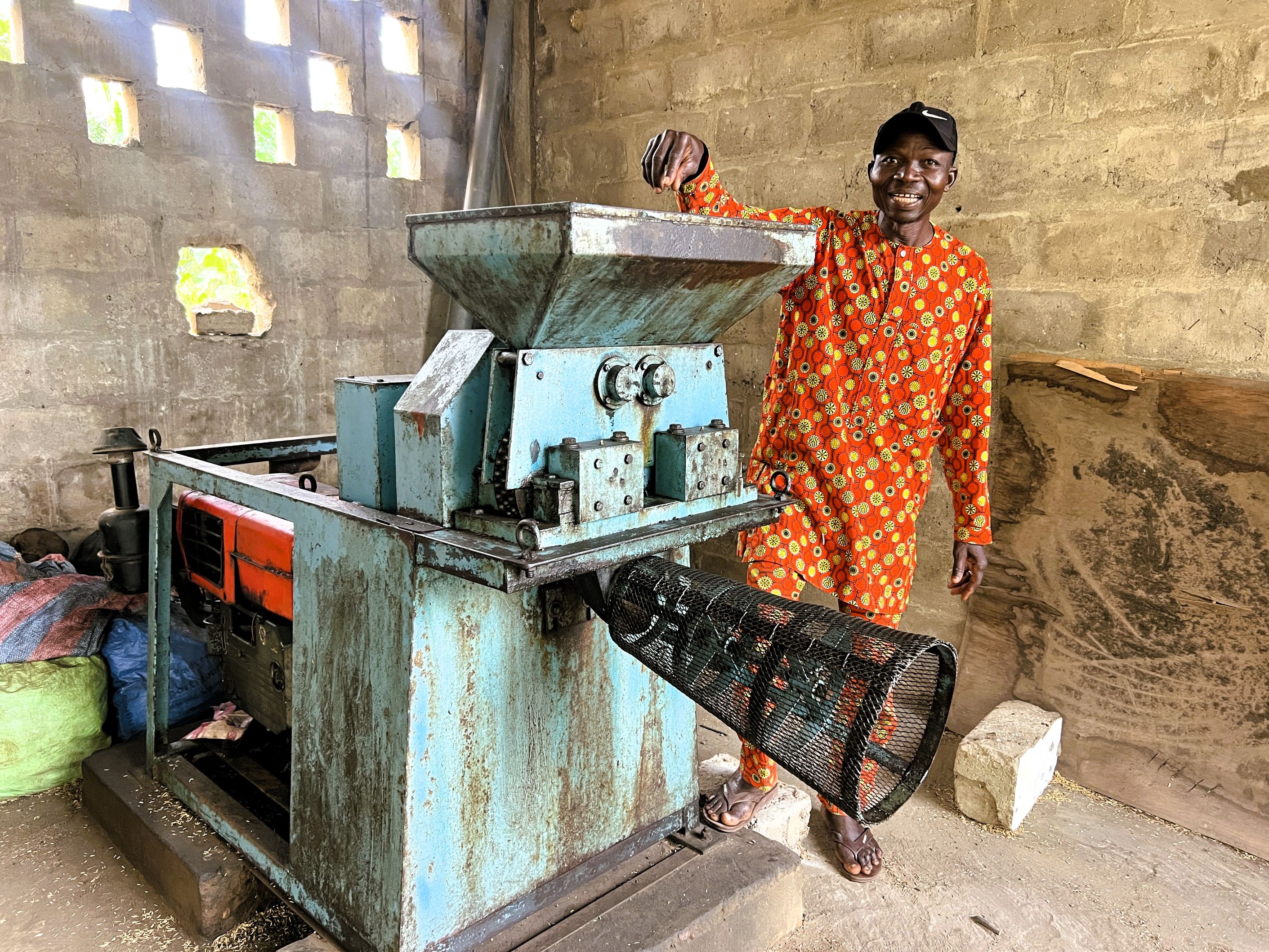 Mr Ahitchékpon Nestor with capacity building support from SAA under the PHRDG II project now operates the only functional urea briquetting machine in Benin Republic.
Mr Ahitchékpon Nestor with capacity building support from SAA under the PHRDG II project now operates the only functional urea briquetting machine in Benin Republic.
SAA and its partners brought in experts to train farmers on the machine’s operation, maintenance, and, crucially, its business potential. Mr. Nestor emerged as the lead beneficiary, mastering the technology and taking responsibility for briquette production in Koussin Lélé. Today, he operates the only functional urea briquetting machine in Benin.
The impact was immediate and visible. As USG was applied on demonstration plots, rice fields grew taller and greener. Farmers watched yields improve and input costs fall. Demand followed evidence.
“Once my neighbors saw the harvest,” Mr. Nestor says with a smile, “they started coming to me. They said, ‘Nestor, make the Bombom for us too.’”
He now charges 3,000 CFA francs (5.3 USD) per 50 kg bag of urea; a service-fee farmers willingly pay because the returns are clear. At the last count, he had 17 confirmed orders, not only from rice farmers but increasingly from maize producers, drawn by the efficiency of briquetted fertilizer. What began as a climate-smart intervention has evolved into a rural enterprise.
During a recent Field Day event in Koussin Lélé, visitors gathered around Mr. Nestor’s demonstration plot, an SAA agriculture extension initiative where his rice field stood as quiet proof of change. Golden panicles bent under the weight of healthy grain. For Mr. Nestor, the numbers tell a deeply personal story.
“Sasakawa has given me a new lease on life,” he told participants. “From this business and my improved harvest, I am feeding my family and paying university fees for my children.”
He supports a household of 18 children, a responsibility that once felt overwhelming. Today, it is a source of pride.
Beyond one farmer’s success, the broader impact is measurable. Improved fertilizer placement reduces nitrogen losses, lowers methane and nitrous oxide emissions, and boosts yields, key pillars of climate-smart agriculture. Scaled across the project’s 12,000 hectares, these practices represent a meaningful contribution to Benin’s climate commitments while strengthening national rice self-sufficiency.
In Covè, a machine once left to rust has become a symbol of possibility. In Mr. Nestor’s hands, decarbonization is no longer an abstract policy goal, it is a livelihood, a business, and a pathway to education for the next generation.
As the sun sets over the paddies, the water still glistens. But beneath the surface, something fundamental has changed. Rice is growing with fewer emissions, farmers are earning more with less waste, and communities like Koussin Lélé are proving that climate solutions work best when they begin with people.
SAA Publications
E-newsletter
"Walking with the Farmer"
SAA publishes a bimonthly e-newsletter reporting on SAA activities.
SAA Mail News
Sign up to receive our e-newsletter and upcoming event information via email.

SAA history book
"Walking with the Farmer: The journey of the Sasakawa Africa Assoication since 1986"
This book chronicles the history of SAA from its inception to the present.

Annual Report
Annual Report FY2023
Annual Report FY2023 is available here.


