【Farmers' story】From struggling to confidence: How Climate-Smart Rice Farming Transformed Patrice Hongbete’s Future in Benin
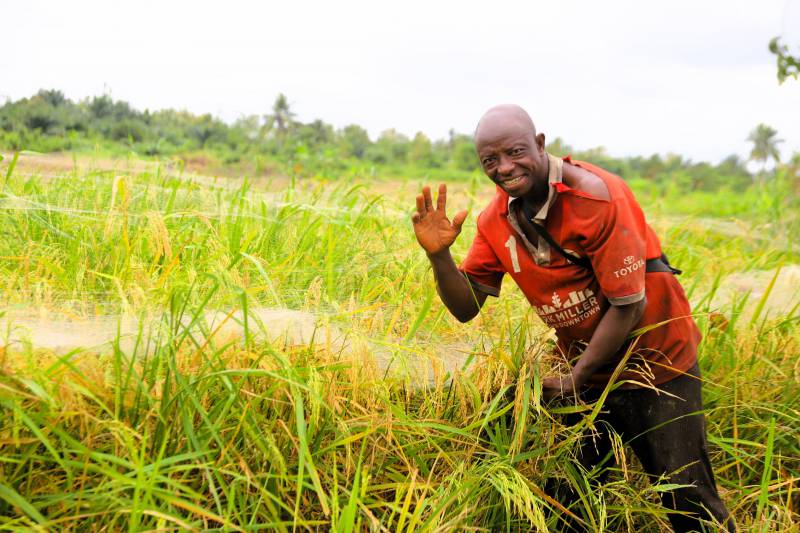
Mr. Patrice Hongbete in Tchi Ahomandégbé community now uses less seed and farms less land, but farms it better using SAA climate smart technologies.
The Struggle of a Schoolteacher and Farmer
In the quiet farming community of Tchi-Ahomandégbé in Benin’s Lalo District, mornings used to begin early for Patrice Hongbete, not with hope, but with careful calculation. As a schoolteacher, he had spent most of his adult life shaping young minds. Yet his modest civil service salary barely covered the needs of his large household. As a father of ten children and husband to three wives, Patrice constantly faced the reality that his income simply was not enough. up. “To survive, I had to farm,” he says. Rice farming became his lifeline. But it was a lifeline tangled with challenges.
Breaking the Cycle of Habit and Debt
Like many rice farmers in his community, Patrice farmed the way he had always seen others farm through habit and tradition rather than scientific methods. He broadcast rice seedlings by hand, using more seed than necessary. Plants grew too closely, competing for air and nutrients. Fertilizers were scattered across flooded fields, often washed away by wind and water before crops could benefit from them. Continuous flooding damaged fields and degraded soil health. Rising labor costs, and expensive farm inputs turned every season into a gamble.
Worst of all, he was stuck with old rice varieties, grains suitable mainly for household consumption, with limited market value. To compensate for low productivity, Patrice expanded outward instead of improving efficiency., He cultivated as much as five hectares of land, hoping that more land would mean more income, but the returns remained thin. After harvest, he paid 30,000 FCFA (48.6 USD) per ton just to transport his paddy from the farm to storage. “I was farming more land,” he recalls, “but earning very little. Everything I gained was swallowed by costs.”
Discovering a New Way to Farm
Respite came to Patrice when Sasakawa Africa Association (SAA) and partners arrived in his community under the Japan Policy and Human Resource Development Grant (PHRDG), funded by the African Development Bank (AfDB). The project, “Improving Rice Productivity by Decarbonizing Cultivation for 12,000 Hectares of Irrigated Paddy Fields in the Republic of Benin”, introduced farmers to regenerative and climate smart rice farming practices.
What he saw challenged everything he believed about rice production.
Under SAA field demonstrations, instead of broadcasting seedlings, farmers learned to raise nursery beds and transplant rice seedings at 14 days old, placing one seedling per hill in well-spaced rows. This allowed stronger root development and better aeration. Farmers also adopted Alternate Wetting and Drying (AWD) irrigation reducing water waste, preventing crop loss, and lowering methane emissions. Urea briquettes replaced indiscriminate fertilizer broadcasting, improving nutrient uptake while reducing pollution. Meanwhile, biochar helped restore soil health that had been lost over years of degradation. “At first, it didn’t make sense to me,” Patrice admits. “They were saying: farm less land but manage it better. I had always believed more land was the answer.”
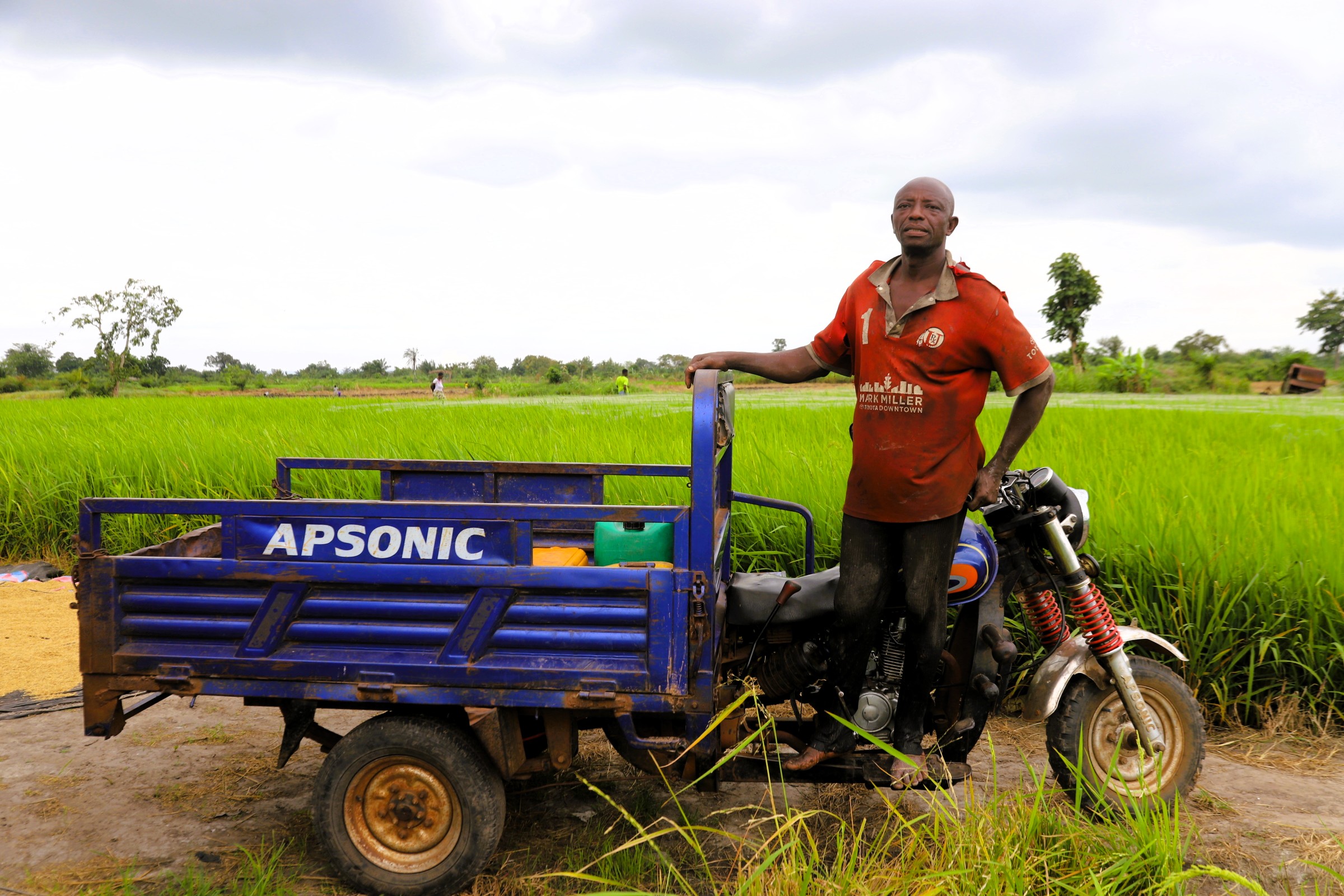 Through enhance yield, Patrice bought his own tricycle crushing 30,000 FCFA transportation cost to just 6,000 FCFA spent on fueling his three-wheeler.
The Power of "Less is More"
Still, the evidence was hard to ignore. Demonstration plots were outperforming traditional fields. Crops were healthier. Yields were higher. Costs were lower. Encouraged by what he saw, Patrice made a bold decision.
He reduced his cultivated area from five hectares to 3.5 hectares, committed fully to the regenerative practices promoted by SAA and its partners. He adopted precise transplanting, practiced AWD water management, and applied fertilizer with care rather than excess. The results stunned him.
Despite farming significantly less land, Patrice harvested 10 tons of rice, the same volume he previously struggled to achieve on a much larger area o. This time, however, the numbers finally worked in his favor. Lower labor requirements, reduced seed and fertilizer use, and better water management increased his profit margin.
One decision captured the transformation perfectly. With the money saved from improved efficiency, Patrice purchased a tricycle to transport his harvest. What once cost him 30,000 FCFA per ton now costs just 6,000 FCFA in fuel. “That alone changed everything,” he says. “I am no longer giving away my profits on the road.”
From Suffering to Sustainability: Harvesting a Brighter Tomorrow
Today, Patrice Hongbete is no longer merely coping he is planning. School fees are paid without panic. Household needs are met with confidence. And his role in the community has shifted from struggling farmer to local leader.
He now trains 20 young people in Tchi-Ahomandégbé on climate-smart rice farming, passing on knowledge that took him years of hardship to acquire. His fields have become informal classrooms, showing that productivity, profitability, and environmental responsibility can go hand in hand.
“I couldn’t support my family on my salary alone,” Patrice reflects. “Rice income is essential. But now, rice farming is no longer suffering, it is a future.”
In a region where farming has long been associated with exhaustion and uncertainty, Patrice’s story is rewriting expectations. By embracing regenerative, climate-smart agriculture, he has proven that the solution to poverty is not always more land or more labor, but better knowledge, better tools, and the courage to change.
SAA Publications
E-newsletter
"Walking with the Farmer"
SAA publishes a bimonthly e-newsletter reporting on SAA activities.
SAA Mail News
Sign up to receive our e-newsletter and upcoming event information via email.

SAA history book
"Walking with the Farmer: The journey of the Sasakawa Africa Assoication since 1986"
This book chronicles the history of SAA from its inception to the present.

Annual Report
Annual Report FY2023
Annual Report FY2023 is available here.


