【Activity】Market Access, Local Finance, and Improved Seeds Drive Nigerian Farmers from Subsistence to Self-Financed, Profitable Agriculture
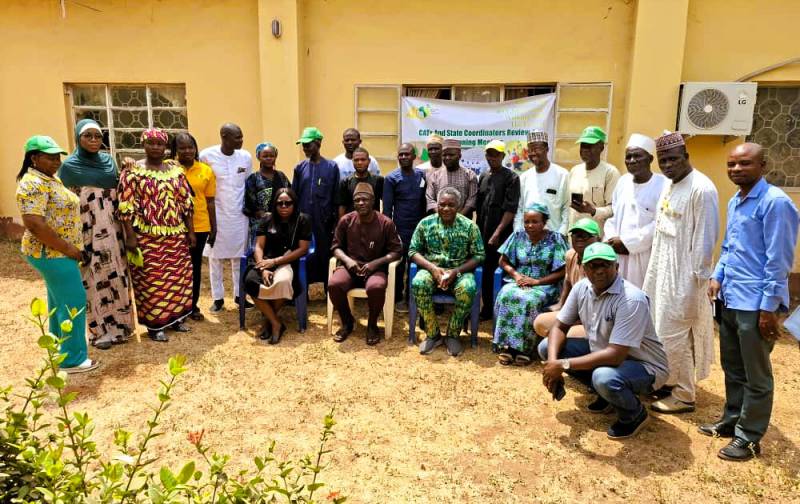
The Sasakawa Africa Association (SAA) Nigeria has reviewed its 2025 achievements in Market-Oriented Agriculture (MOA) and laid out a clear pathway for scaling impact in 2026 during a two-day Commodity Association Traders and Trainers (CATs) and State Coordinators Review and Planning Meeting held from 10–11 February 2026 in Lafia, Nasarawa state.
Funded by The Nippon Foundation (TNF), the meeting provided an opportunity to assess progress and strengthen strategies aimed at helping Nigerian farmers transition from subsistence farming to market-driven and profitable agricultural enterprises.
Strengthening Market-Oriented Agriculture Extension
While SAA-supported farmers have recorded gains in productivity and market participation, challenges such as weak market linkages, uneven extension coverage, limited access to affordable finance, and climate-related risks continue to constrain income growth. The meeting therefore served as a strategic platform for stakeholders working directly with farmers to review progress, address operational gaps, and align behind a more coordinated, and market-responsive extension system for 2026.
Hosted at the Nasarawa Agricultural Development Programme (NADP), the meeting brought together State Coordinators from six states, 16 CATs from Kano, Jigawa, Gombe, Nasarawa, Benue, and Kwara states, alongside technical staff from SAA’s Regenerative Agriculture (RA), Nutrition-Sensitive Agriculture (NSA), and MOA, as well as the Program Manager of NADP.
Bringing Extension Closer to Farmers
Declaring the meeting open, SAA Nigeria Country Director, Dr. Godwin Atser, emphasized that sustainable agricultural transformation depends on proximity and trust between extension services and farming communities. He stressed the importance of deploying Extension Agents (EAs), Community-Based Facilitators (CBFs), and CATs within the communities they serve, ensuring farmers have continuous access to advisory services. According to Dr. Atser, farmers do not experience agricultural challenges in isolation. “Farmers do not separate extension advice into pillars,” he noted. “They expect practical solutions that link production, nutrition, and markets.
He also reminded the State Coordinators that all field support staff across SAA’s pillars operate under their direct supervision, emphasizing the importance of accountability and performance management in delivering measurable results at the farm and market levels.
Farmers Transitioning to a “Grow-to-Sell” Mindset
A key highlight of the meeting was the presentation of the MOA team’s 2025 achievements by Mr Jonathan Taknan Yassah, SAA Program Officer, who demonstrated how targeted market interventions are reshaping farmer behavior across SAA-supported states.
“What we are seeing is a clear transition from subsistence farming to a ‘grow-to-sell’ mindset,” Yassah explained. “Through collective marketing, access to quality inputs, and the promotion of Community Savings for Investment in Agribusiness (CSIA), farmers are financing their own production and making informed decisions based on market demand.”
He noted that collective input sourcing and commodity marketing helped farmers reduce transaction costs and strengthen their bargaining power. At the same time, improved seed multiplication, early maturing and climate-tolerant varieties, and stronger linkages with input dealers and financial institutions are making production more market-oriented and resilient.
Field Experiences from State Coordinators
State Coordinators shared evidence of these changes across different project states. Mrs. Comfort Anum, SAA State Coordinator in Benue State, explained that collective action has improved farmers’ confidence and market participation. “Farmers are no longer producing blindly,” she said. “They are organizing themselves, saving together, and approaching the market with better quality produce. This has improved incomes and strengthened trust in the extension system.”
From Kano State, Mr. Kassim Safiyanu, SAA State Coordinator, highlighted the role of local finance mechanisms in sustaining these gains. “CSIA has been very useful to many farmer groups,” he noted. “It allows farmers to invest in inputs on time, reduce dependence on loans, and build resilience within their own communities.”
Community-Level Impact
At the community level, CATs shared practical examples of how the MOA approach is translating into results. Mr. Masud Ibrahim Idris, a SAA CAT based in Lafia, Nasarawa State, said farmers now clearly see in the benefits of working together. “When farmers market collectively and use improved seeds, they see the difference immediately in yield, quality, and price,” he said. “Our role is to guide them and ensure the link between production and the market is clear.”
Addressing Remaining Challenges
Despite these achievements, participants acknowledged lingering challenges, including inconsistent reporting, uneven field staff performance, security concerns in some locations, and limited access to reliable market intelligence. Lessons from 2025 implementation period reinforced the need for stronger coordination, continuous retraining of field staff, and closer integration of extension services, financial institutions, and market actors.
Priorities for Scaling Impact in 2026
Building on these insights, participants jointly developed a 2026 workplan focused on scaling successful interventions. Priorities include expanding collective marketing initiatives, increasing adoption of CSIA, strengthening linkages with input suppliers and financial service providers, and stepping down continuous training on the Smallholder Horticulture Empowerment and Promotion (SHEP) approach, Good Agricultural Practices (GAP), Community-Based Seed Multiplication (CBSM), and backyard gardening.
To support effective delivery, CATs were retrained on standardized reporting templates, while new resolutions reinforced collaboration between EAs, CBFs, and CATs, introduced mandatory quarterly reporting, and empowered State Coordinators to address persistent field staff performance gaps. Participants also emphasized the need to prioritize accessible and secure locations for demonstrations and farmer engagements.
The meeting also agreed to institutionalize periodic virtual review meetings to monitor progress and address emerging issues promptly. Farmers’ Organization engagements with input suppliers and other market actors are scheduled for March 2026, while the next CATs and State Coordinators Review Meeting will be held in January 2027 in Benue State.
As SAA Nigeria moves into 2026 implementation cycle, the meeting reaffirmed a clear pathway for transforming smallholder agriculture: bring extension services closer to farmers, link production to markets, strengthen local finance systems, and promoting improved seeds. Together, these strategies are helping Nigerian farmers to move beyond subsistence agriculture toward profitable, self-financed agricultural enterprises.
SAA Publications
E-newsletter
"Walking with the Farmer"
SAA publishes a bimonthly e-newsletter reporting on SAA activities.
SAA Mail News
Sign up to receive our e-newsletter and upcoming event information via email.

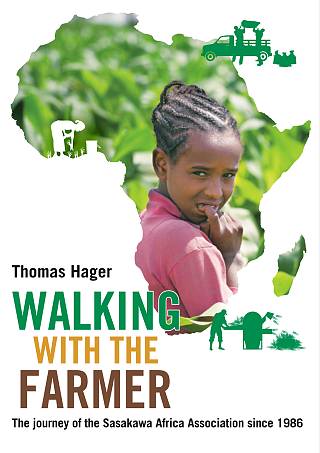
SAA history book
"Walking with the Farmer: The journey of the Sasakawa Africa Assoication since 1986"
This book chronicles the history of SAA from its inception to the present.

Annual Report
Annual Report FY2023
Annual Report FY2023 is available here.


