【Farmers' story】Regenerative Agriculture in Uganda: How Soil Restoration Increased Income and Climate Resilience for a Smallholder Farmer

For years, 43-year-old Lutankome Ronald farmed the way his parents and grandparents had taught him. On 2 ha (5 acres) of inherited land in Lusana Village, Kiboga District, he grew bananas and coffee using traditional practices passed down through generations. The land fed his family but only just. Yields were declining, rains were unpredictable, and income was uncertain. As a father of six, Ronald worried not only about harvests, but about the future of his farm. Like many smallholder farmers, he believed this was simply “how farming is.”
A Chance Encounter, A Turning Point
Everything changed in 2024, unexpectedly. While visiting a friend at the Kiboga District offices, Ronald noticed a small group of farmers gathered under a tree listening intently to an extension officer. Curious, he paused to listen. That spontaneous moment marked the beginning of transformation.
The session was being facilitated by Sasakawa Africa Association (SAA), introducing farmers to Regenerative Agriculture, with support from The Nippon Foundation. Ronald didn’t attend just once, he e showed up again. And again. Through hands-on training and continuous learning, Ronald began to understand something he had never been taught before: his soil was exhausted but it could be restored.
Rebuilding the Farm from the Soil Up
With guidance from SAA, began applying regenerative practices across his banana and coffee gardens. He learned heavily to conserve soil moisture, to recycle manure from cows and goats to rebuild soil fertility, to use fertilizers correctly and efficiently, and apply biochar to improve soil structure and nutrient retention. These weren’t abstract concepts, they were practical techniques he applied season after season.
Gradually, the land began to respond. The soil grew darker and richer. Moisture lasted longer. Coffee trees strengthened. Banana plants survived dry spells that damaged neighboring fields.
Income More Than Quadruples
Then the results become measurable. Before adopting regenerative practices, Ronald earned about USD 421 per acre (0.4ha) of coffee per harvest. Today, from the same acres, he earns between USD 1685 and 1966 per season more than four times his previous income. With two harvests per year, his coffee enterprise alone now provides stable, and reliable earnings. “I thought my harvests were normal,” Ronald says. “I did not know the soil was exhausted. When I started mulching, using manure, and applying biochar, everything changed.
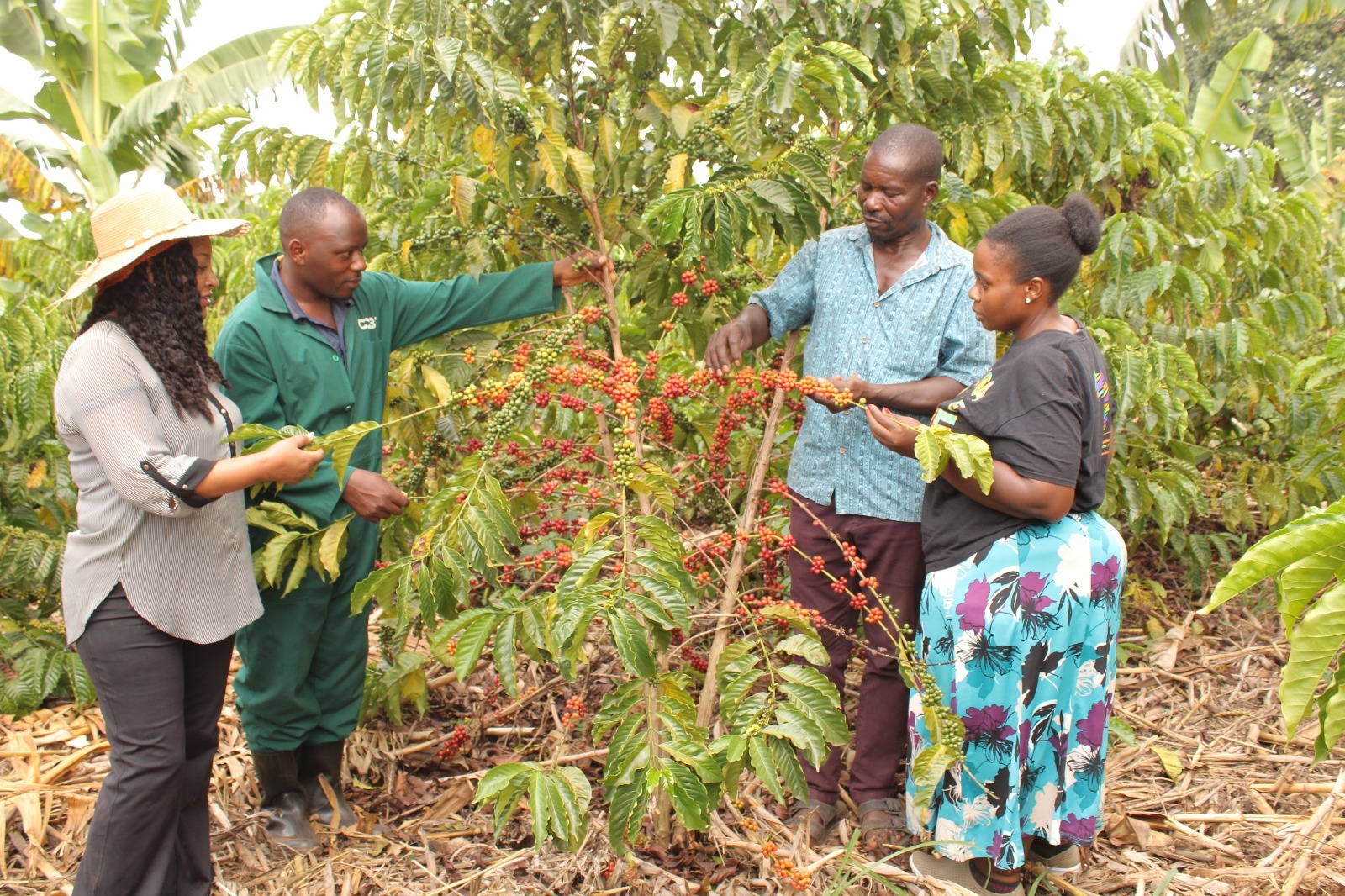 SAA staff, a CCBF, and Mr. Lutankome are jointly assessing crop performance and demonstrating hands-on support for RA.
Climate Resilience in Practice
The most visible impact came during the dry season. While neighboring farms struggled with moisture stress, Ronald’s fields remained green and productive. “Even when the rains delay, my crops survive,” he says with quiet pride. “Now my garden teaches other farmers without me saying much.” Ronald’s farm has become an informal demonstration site. Neighbors visit to see what healthy soil looks like. Farmers ask questions. Some have already begun adopting regenerative practices themselves.
Restoring Soil, Restoring Confidence
What began as a chance encounter has grown into a model of climate resilience and income security. Regenerative agriculture did more than restore soil fertility, it restored Ronald’s confidence, strengthened his household income, and secure his family’s future. His story reflects the core of SAA’s approach: walking with the Farmer, rebuilding from the soil up, and demonstrating that climate-smart farming can also be profitable to agriculture. For Ronald and his family, the land is no longer barely surviving. It is productive, resilient, and working for today, and for generations to come.
SAA Publications
E-newsletter
"Walking with the Farmer"
SAA publishes a bimonthly e-newsletter reporting on SAA activities.
SAA Mail News
Sign up to receive our e-newsletter and upcoming event information via email.

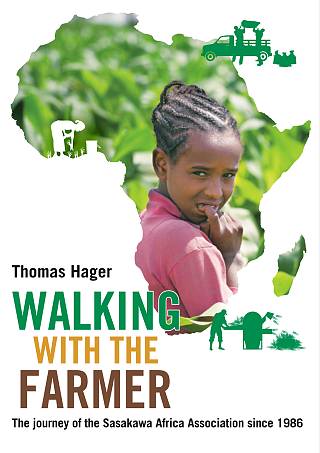
SAA history book
"Walking with the Farmer: The journey of the Sasakawa Africa Assoication since 1986"
This book chronicles the history of SAA from its inception to the present.
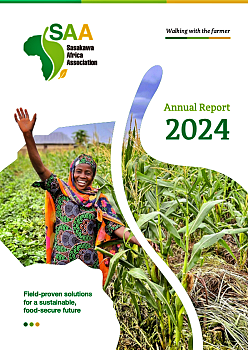
Annual Report
Annual Report FY2024
Annual Report FY2024 is available here.


