Stakeholders Unite to Strengthen Nutrition-Sensitive Agriculture for Healthier Communities in Uganda

Strengthening partnerships to transform Uganda's food systems took centre stage as government institutions, research organizations, development partners, civil society, academia and the private sector joined Sasakawa Africa Association (SAA) Uganda for the Safe, Adequate and Nutritious Food Systems Workshop on 30th June at Golden Tulip Hotel in Kampala Uganda. The workshop served as a platform for building practical solutions to improve household nutrition, strengthen climate-resilient agriculture, and accelerate collective action against malnutrition. A total of 33 against the targeted 21 stakeholders participated, reaffirming a shared commitment to ensuring that agriculture contributes not only to increased production, but also to healthier diets and improved livelihoods for Ugandan families.
Despite Uganda's significant agricultural potential, malnutrition remains one of the country's most pressing development challenges, particularly among women and children. Participants agreed that producing more food alone is no longer enough. Agriculture must deliver safe, diverse and nutritious foods while creating resilient livelihoods and sustainable food systems capable of withstanding climate and economic shocks. The workshop therefore focused on strengthening collaboration across agriculture, health, education, research and the private sector to address nutrition challenges through integrated action.
A Call for Collective Action
Opening the workshop, SAA Uganda’s Deputy Country Director, Mr. Joseph Paschal Bbemba emphasized that improving nutrition is a shared responsibility that cannot be achieved by a single institution.
"Addressing malnutrition requires researchers, policymakers, extension practitioners, development partners and communities working together. Nutrition is not only a health issue, but also an agricultural, economic and national development priority."
He highlighted SAA's integrated approach, which combines climate-smart agriculture, Nutrition Model Homes, post-harvest management, biofortified crops, nutrition education and market linkages to help farming households improve both food security and nutrition outcomes. Participants were challenged to move beyond dialogue by identifying practical opportunities for joint programming, knowledge sharing and stronger institutional coordination.
Officially opening the workshop, Hon. Susan Abeja Julie, Woman Member of Parliament for Otuke District and Parliament Commissioner, called for stronger collaboration across the entire food system, reminding participants that food security extends far beyond production.
"Food security starts with me. Every leader, farmer, researcher, parent and citizen has a role to play in ensuring that every Ugandan has access to adequate, safe and nutritious food."
She challenged stakeholders to translate research into practical action, strengthen food safety across the value chain, reduce post-harvest losses and increase investment in nutrition-sensitive agriculture and school feeding programmes. Her call reinforced the need to bridge policy, research and community practice to deliver measurable improvements in people's lives.
 A cross-section of participants during the workshop discussions
Research and Innovation Driving Better Nutrition
A major highlight of the workshop was the presentation by Dr. Moses Matovu of the National Agricultural Research Organization (NARO), who demonstrated how agricultural research is contributing to improved nutrition through biofortified crops and innovative food safety technologies. While Uganda has made progress, he noted that many households continue to suffer from "hidden hunger" caused by diets lacking essential micronutrients such as iron, zinc and vitamin A.
Participants explored practical solutions including wider adoption of biofortified maize, beans, orange-fleshed sweet potatoes and other nutrient-rich crops, alongside improved post-harvest handling and food safety technologies that reduce aflatoxin contamination. Discussions emphasised the importance of translating scientific knowledge into farmer-friendly extension messages and expanding access to improved planting materials to ensure research reaches communities where it is needed most.
The Ministry of Agriculture, Animal Industry and Fisheries (MAAIF) reaffirmed Government's commitment to strengthening partnerships that advance food and nutrition security. Ministry representatives encouraged development partners to align their interventions with national agricultural and nutrition priorities outlined in the Agriculture Sector Growth and Transformation Programme and the Ministry's Strategic Plan, creating opportunities for stronger coordination, reduced duplication and greater impact.
A New Strategy Focused on Impact
Presenting SAA's new Strategic Plan and Monitoring, Evaluation and Learning (MEL) Strategy, Dr. Frances Nakakawa demonstrated how nutrition is embedded across all of the organization's programmes from climate-resilient agriculture and inclusive markets to safe and nutritious food systems. Rather than measuring success only by the number of farmers trained, SAA will increasingly focus on outcomes such as improved dietary diversity, adoption of nutrition-sensitive farming practices, increased household incomes and reduced post-harvest losses.
"Nutrition is not a standalone intervention. It is the outcome of resilient agricultural systems, stronger markets and informed household decisions."
Participants welcomed this shift toward outcome-based programming while emphasizing the importance of maintaining strong monitoring systems that capture both programme outputs and long-term impacts.
 Hon. Susan Jolly Abeja, Woman Member of Parliament for Otuke District and Commissioner of Parliament, delivers the keynote remarks at the Stakeholders' Workshop.
Understanding Uganda's Nutrition Challenge
Evidence presented by the Ministry of Health highlighted both encouraging progress and persistent challenges in Uganda's nutrition landscape. National data show declining levels of stunting, underweight and wasting among children under five. However, regional disparities remain significant, particularly in Karamoja, while anaemia, inadequate dietary diversity and the rising burden of overweight and obesity continue to threaten public health. Ms. Laura Ahumuza Turinawe concluded her presentation by saying;
"The future of Uganda is being shaped today in our homes, our farms, our schools and our communities. By investing in nutrition, we are investing in human capital, economic growth and the wellbeing of future generations. Let us work together to ensure that no child is left behind and that every Ugandan has the opportunity to live a healthy, productive and dignified life."
The discussions also highlighted concerns around school feeding, with many learners still attending school without nutritious meals. Participants agreed that improving dietary quality, not simply food availability, should become a priority in future nutrition interventions.
Another innovation that attracted significant interest was SAA's Nutrition Model Homes, which transform volunteer farmers' homes into community learning centres where families receive practical training on nutrition, hygiene, food preparation, kitchen gardening, biofortified crops and post-harvest handling. Jacqueline Namusalisi - the Technical Coordinator for Nutrition Food Systems explained how the model provides a hands-on approach that allows communities to learn directly from fellow farmers in real-life settings.
Participants recognized the model's potential to strengthen behaviour change at household level and recommended expanding it into centres of excellence while strengthening collaboration with Government extension systems, Village Health Teams and schools.
Key Commitments for the Future
Beyond knowledge sharing, the workshop produced tangible outcomes. Stakeholders committed to strengthening collaboration between agriculture, health, mechanization and nutrition sectors; promoting wider adoption of biofortified crops; improving food safety; expanding nutrition education through extension services; supporting school feeding initiatives; strengthening Monitoring, Evaluation and Learning systems; and increasing investment in evidence-based programming. These commitments are expected to guide future joint action and contribute to healthier diets, stronger food systems and improved livelihoods across Uganda.
As Uganda continues its journey toward eliminating malnutrition, the workshop demonstrated that sustainable solutions lie in stronger partnerships, evidence-driven programming and community-centred innovation. By bringing together government, researchers, development partners and farming communities around a shared vision, SAA reaffirmed its commitment to walking with the farmer to build resilient agrifood systems that improve food, nutrition and income security for generations to come.
 SAA Deputy Country Director, Mr. Joseph Bbemba, delivers the welcome remarks.
SAA Publications
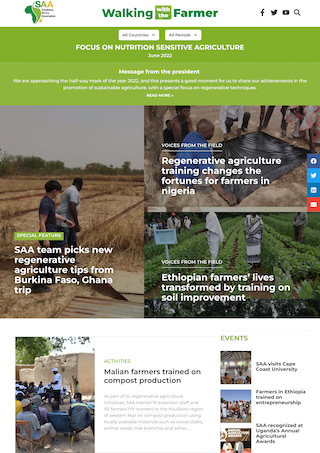
E-newsletter
"Walking with the Farmer"
SAA publishes a bimonthly e-newsletter reporting on SAA activities.
SAA Mail News
Sign up to receive our e-newsletter and upcoming event information via email.

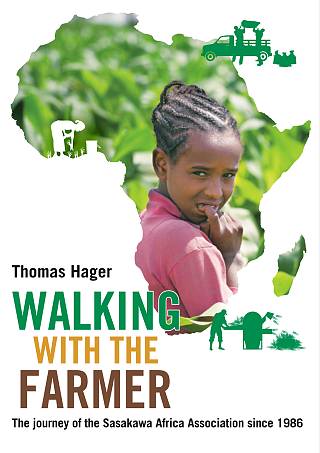
SAA history book
"Walking with the Farmer: The journey of the Sasakawa Africa Assoication since 1986"
This book chronicles the history of SAA from its inception to the present.
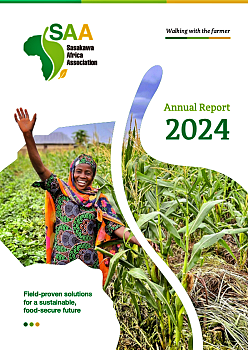
Annual Report
Annual Report FY2024
Annual Report FY2024 is available here.


