Catalysing Rural Transformation through the CCBF Model: Insights from the 2025 SAA Annual Stakeholders’ Workshop
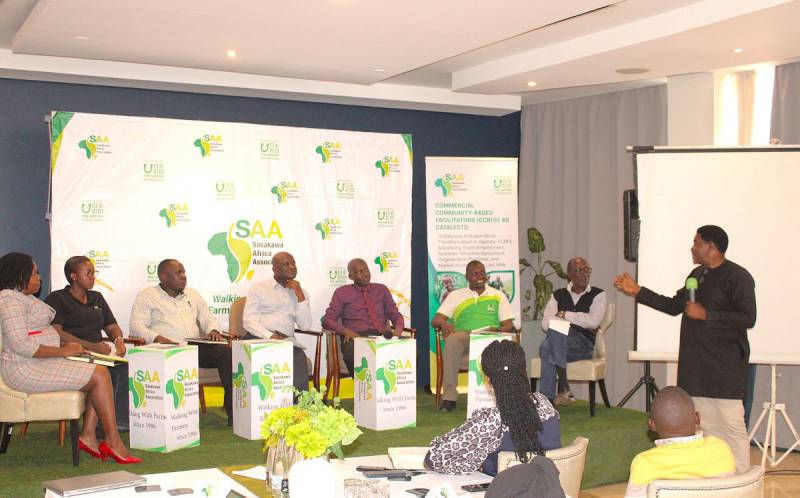
On 15th May 2025, the SAA hosted its Annual Stakeholders’ Workshop at the Golden Tulip Hotel in Kampala, convening over 120 participants under the theme “Catalysing Inclusive Rural Transformation in Uganda: CCBFs Advancing Youth Employment, Nutrition-Sensitive Agriculture, Regenerative Practices, and Market Access at the Last Mile.” This high-level event brought together government officials, private sector actors, development partners, financial institutions, farmer organizations, and Community-Based Commercial Facilitators (CCBFs), all united by a shared goal to accelerate inclusive agricultural growth and sustainability through SAA’s proven CCBF model.
The workshop was officially opened by SAA Uganda’s Country Director, Mr. Robert Anyang, who set the tone with a call for sustainability in development interventions. “As donor funding continues to decline and financial institutions grow more risk-averse, we must evolve. The future of agriculture lies in commercially viable, community-embedded solutions like the CCBF model,” he remarked. He emphasized the need to empower CCBFs to profile viable farmers, supply irrigation kits, and act as local agri-business champions.
In his keynote address, Mr. Shuich SUZUKI, President of SAA, reaffirmed the organization’s commitment to supporting Uganda’s agricultural transformation journey. “I am deeply impressed by how the CCBF model is scaling impact across Uganda. Let us continue to innovate and collaborate to reach even the most underserved communities,” he stated.
Representing the Ministry of Agriculture, Animal Industry and Fisheries (MAAIF), Commissioner Stephen Tibujuka emphasized alignment with Uganda’s Agricultural Value Chain Strategy and urged stakeholders to focus on production, value addition, and market access. “We must ensure that agriculture is not just about food but also about incomes, jobs, and dignity,” he said. He further identified six strategic priorities for immediate intervention, including certified seed access, mechanization, irrigation, aquaculture, and strengthened extension systems.

Mr. Stephen Tibujuka, Commissioner for Crop Protection at MAAIF, delivering his remarks as the Guest of Honour.
Dr. Frances Nakakawa, SAA’s M&E Technical Coordinator, provided a comprehensive overview of the CCBF model’s achievements and lessons learned, She said “We now have 128 trained and active CCBFs. 67% of farmers supported under the model have reduced vulnerability to climate change, 72% have adopted improved technologies, and household incomes have increased by 64%.” These results were attributed to the model’s integrated approach combining training, incentives, market access, and financial linkages. “We’ve moved from stipend-based to performance-based engagement. CCBFs now earn through farmer reach, input sales, and mechanization services, making the model self-sustaining,” she explained.
During an engaging panel session, CCBFs from different districts shared their lived experiences in implementing the model. Abdul Seryaazi from Luweero noted, “There is growing demand for mechanization and value-added services. With SAA’s support, I’ve expanded my work to cover three sub-counties. The biggest challenge now is access to reliable irrigation equipment and affordable inputs, but the potential for impact is huge.” Otim Bright from Otuke added, “Our cooperative supplies over 250 tonnes of maize to Aponye, thanks to the structured market systems supported by SAA and MAAIF. We’ve come a long way from subsistence to commercial agriculture.”
Namuganza Thierty from Kamuli spoke passionately about the health-nutrition link, saying, “We used to see many children born with cancer and diabetes in our communities. But through nutrition education and promoting better diets, these cases are reducing. We now see health and agriculture working hand in hand.” Similarly, Michael Asaba from Kamwenge shared, “Despite having just six jab planters, we serve over 1,000 farmers. With the right support, we offer planting, spraying, shelling and even free training. We’ve reduced production costs and increased productivity in a short time.”
Digital integration and innovation also took center stage during the panel moderated by ISSDA’s Monalisa Mutesi. “We’re using AI-powered tools like the Virtual Agronomist App to guide fertilizer use and pest management. Through MobiPay, farmers can pay for inputs digitally, making transactions faster and more transparent. The key is building digital literacy among youth to fully leverage these innovations,” she explained.
The policy reflection by Dr. Edward Katende provided a comprehensive overview of how the CCBF model complements the government’s Parish Development Model (PDM), which has so far allocated UGX 2.7 trillion to uplift rural households. “CCBFs must operate like mobile money agents earning through service delivery. That’s the future. The role of government and partners like SAA is to set systems, certify, and support not to subsidize forever,” he asserted. He called for CCBFs to align with District Enterprise Strategies and take advantage of verified suppliers and enterprise-specific value chains. “Let’s certify them, equip them, and let them fly,” he said.
A second panel involving key ecosystem players Centenary Bank, VisionFund, NASECO, Wash & Wills, Kironde Agro, and ISSDA, explored practical solutions to boost innovation access. Sarah Natukunda from VisionFund noted, “We offer tailored loans like the Echo Loan for solar irrigation and Asset Loans for productive equipment. Our goal is to ensure CCBFs have what they need to serve their communities.” Alanga Faith of Centenary Bank added, “We have VSLA financing up to UGX 300 million, solar irrigation loans, and even youth-specific products. But CCBFs must be selective in farmer targeting and accountable in service delivery.”
 Panelists share experiences on transitioning from CBFs to CCBFs, highlighting mindset change, sustainability, and job creation. Panelists Included: Left to right: Michael Asaba (Kamwenge District), Yoweri Zungu (Kibuku District), Kizito Otim Bright (Otuke District), Namuganza Bridget (Kamuli District), and Abdul (Zika, Luweero District).
The discussion also delved into issues of seed quality and mechanization. “We monitor seed quality digitally through the Virtual Agronomist App. It’s linked to extension agents, ensuring seed traceability,” said Godfrey Katwere from NASECO. Douglas Opio of China North emphasized, “We’re working with Wash & Wills to provide tractors that are tested for soil compatibility. Financing is available through our 70/30 partnership with Equity Bank.”
Participants also posed critical questions to MAAIF, with calls for scaling up CCBFs, integrating them into government programs, and strengthening access to fish fry, jab planters, and structured markets. Dr. Paul Ayera of MAAIF emphasized public-private synergy, saying, “Let’s align extension services with digital innovations and build traceable systems to enhance trust and scale.”
In her final remarks, Ms. Cony Acayo of MAAIF expressed gratitude to all stakeholders and encouraged stronger district-level accountability. “We must not repeat past mistakes, like the failed goat export due to lack of standards. Let’s focus on quality, coordination, and shared responsibility,” she emphasized. She urged financial institutions to improve communication with farmers and called for increased visibility of licensed agricultural insurance providers.
The workshop concluded with a resounding call to action by SAA’s Deputy Country Director, Mr Joseph Pascal Bbemba urging all partners to continue scaling the CCBF model as a viable pathway to rural transformation.
The 2025 Annual Stakeholders’ Workshop was not just a platform for dialogue; it was a call to action. SAA remains committed to working with all stakeholders to empower CCBFs and ensure that smallholder farmers in Uganda have access to the tools, knowledge, and support needed to thrive in an increasingly complex agricultural landscape.
 A cross-section of panelists sharing a light moment after the workshop.
SAA Publications
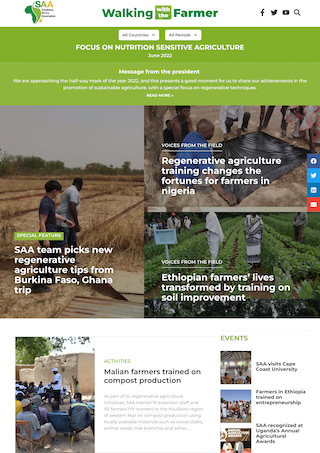
E-newsletter
"Walking with the Farmer"
SAA publishes a bimonthly e-newsletter reporting on SAA activities.
SAA Mail News
Sign up to receive our e-newsletter and upcoming event information via email.

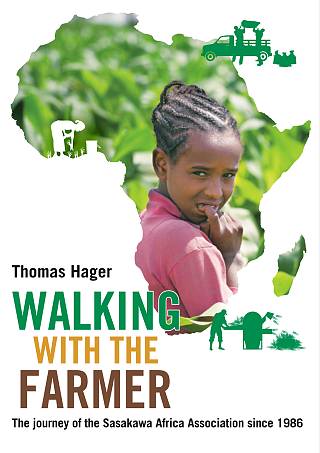
SAA history book
"Walking with the Farmer: The journey of the Sasakawa Africa Assoication since 1986"
This book chronicles the history of SAA from its inception to the present.

Annual Report
Annual Report FY2023
Annual Report FY2023 is available here.


